
Quick Summary:
Before you increase your ad budget or bring in another agency take a look, at five things that quietly drain the money you’re already spending: how fast you respond, your landing pages, online reviews, your tracking system and what you consider a good lead. This post walks you through how to test each one in a few hours.
Introduction
Sales are not growing so you choose to invest money. You plan to increase the advertising budget hire another person who works on your projects or bring in a company that has a strong presentation. It seems like the thing to do. Marketing helped in the past so putting money into it should lead to better results.
Sometimes it works.. A lot of small business marketing fails at a point that no one pays attention to: the moments right after someone shows interest. A phone call goes to voicemail. A form submission stays in an inbox until Monday. A website page takes six seconds to load on a phone. When you spend money you send more people into those same problems.
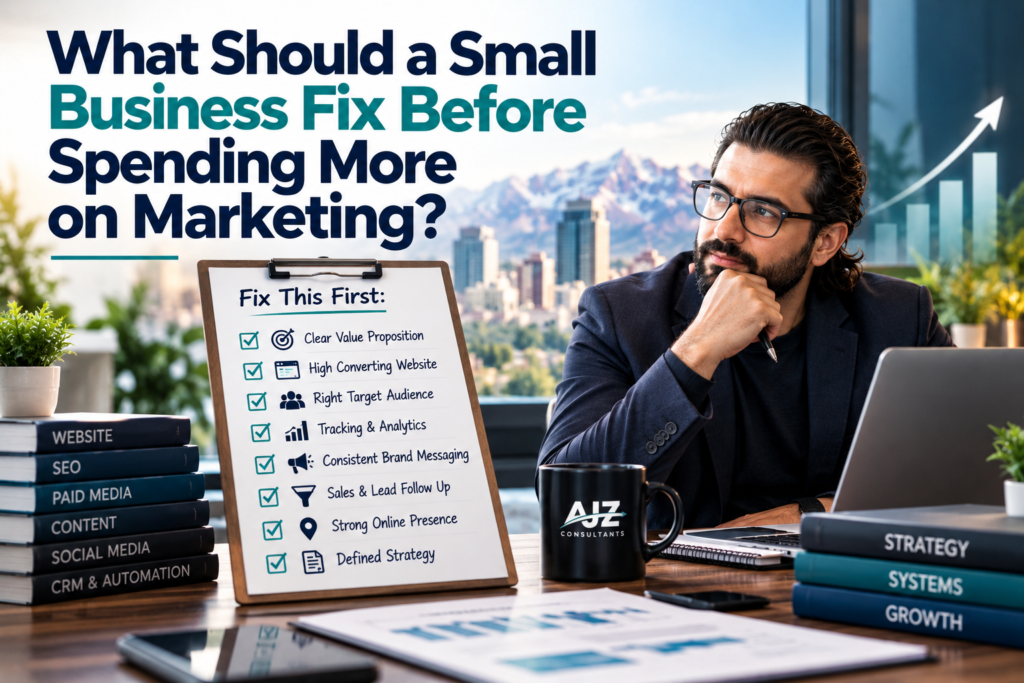
So before you increase the budget look at the things that determine whether your current spending turns into customers. Five checks cover most of the issues. You can do all of them on your own.
Fix One: How Fast Someone Answers
Start here, because it costs nothing and often explains everything.
Harvard Business Review researchers sent test enquiries to 2,241 US companies. Only 37% replied within an hour, and 23% never replied at all. In a separate study of 1.25 million leads, they found that companies contacting a prospect within an hour were nearly seven times as likely to qualify that lead as companies that waited longer. You can read the full article yourself. It dates from 2011, so treat the exact multiples as a direction, not a guarantee. The behavior behind it hasn’t changed: people contact several businesses at once, and the first useful answer often wins.
Salesforce’s tenth State of Marketing report points the same way. It found that 69% of marketers still struggle to respond promptly to customers, and teams that have satisfactorily unified their data are 42% more likely to respond regularly. Slow replies aren’t a small business problem alone. Bigger teams struggle with them too.
Here’s the test. Submit your own contact form at 7 p.m. Call your main number at lunchtime. Message your chat widget on a Sunday. Time each reply and note what it says. If a real person takes a day to answer, no ad budget will fix that.
Fix Two: The Page Your Visitors Land On
Imagine a person who clicks an advertisement for same day boiler repair and then arrives at a landing page that opens with your company history and a slideshow. That person will not search for the landing page again. That person will tap back. That person will click the result instead.
Two things matter most on a landing page: how fast the landing page loads and whether the landing page keeps the promise that drew the visitor. About speed Google’s mobile research found that fifty‑three percent of visitors leave a landing page that takes longer than three seconds to load. That research is a years old and phones are faster now but the instinct in that research remains the same. No one likes to wait.
About the message Google’s guidelines on people‑first content give a rule: does the landing page meet the visitor’s real need? Open the ad that is performing well and the landing page that follows it side by side. Read them as if you were a stranger. If the headline, offer and next step do not match, rewrite the landing page before buying clicks. A focused review of website conversion usually pays for itself faster, than the cost of advertising.
Fix Three: What Your Reputation Says Before You Do
Many buyers decide before they ever contact you. BrightLocal’s 2026 Local Consumer Review Survey found that 97% of consumers read reviews for local businesses, and 41% now say they always read them, up from 29% the year before. The same research found that just 35% of small and mid sized businesses have a Google Business Profile. You can see the full numbers in BrightLocal’s survey.
So your reviews and listings do a lot of selling for you, or against you. Search your business name and your main service plus your city, on your phone. Look at your star rating, how many reviews you have, how recent they are, and whether your hours, phone number, and address are correct. A competitor with 200 fresh reviews will beat your better service if nobody can see the proof.
Fixing this doesn’t take a campaign. Ask every happy customer for a review at the moment they thank you, reply to the reviews you already have, and correct any wrong details. Local SEO work builds on that foundation, and it works much better once the foundation exists.
Fix Four: Tracking That Matches Reality
If your reports say marketing works and your bank account disagrees, tracking is a suspect.
Google Analytics 4 doesn’t count anything as a conversion until you tell it to. Google’s help page on marking events as key events explains the setup. In practice, businesses often track the contact form and nothing else, so phone calls, chat starts, and booking clicks go uncounted. That makes your best channels look weak. The opposite problem happens too: some businesses mark every button click as a conversion, and the numbers look great and mean nothing.
Test it directly. Place a test call, submit a test form, and start a test chat, then check whether each one appears in your reports with the right source attached. Then check whether your CRM records where each lead came from. Without that, you can measure enquiries but never customers. A proper analytics and CRM setup turns guesses into decisions.
Fix Five: What “A Good Lead” Actually Means
Ask the people who answer your phones and sell your services: “Which enquiries are worth our time?” Then ask the question to whoever handles your marketing. You’ll often hear two answers.
Marketing counts every form submission. Sales only wants people who have a budget a real need and a timeline. Neither side is wrong.. The difference means marketing focuses on getting as many leads as possible while sales spends too much time chasing people who aren’t ready to buy.. Then everyone ends up blaming the other team.
Take your ten enquiries. Go through them one by one. Label each one, as good or bad. Then write down where each one came from. You might find that your cheapest marketing channel brings in bad leads while a small low-cost channel actually sends most of your customers. That simple exercise can change how you spend your marketing budget.
Your Five Minute Checklist
| What to check | A quick test | What it tells you |
|---|---|---|
| Response speed | Submit your own form after hours and time the reply | Whether leads go cold before anyone answers |
| Landing page | Read your ad, then the page, on your phone | Whether the promise and the page match, and load fast |
| Reputation | Search your business name and service plus city | Whether proof of quality is visible to buyers |
| Tracking | Place a test call and form submission | Whether your reports capture what matters |
| Lead definition | Label your last ten enquiries good or bad | Whether marketing and sales aim at the same target |
Which Fix Comes First Depends on Your Business
The order changes with how your customers buy.
| Business type | Usually the first fix | Why |
|---|---|---|
| Local service business | Response speed and call handling | Buyers contact several providers and pick whoever answers |
| Professional practice | Reviews and easy booking | Trust drives the decision, and friction loses nervous first time visitors |
| B2B company | Lead definition and follow up | Long sales cycles punish vague handoffs between marketing and sales |
| Multiple location business | Listings and location level tracking | One weak location hides inside a company wide average |
Pick the row that sounds like you and start there. You don’t need to fix all five at once.
When Spending More Does Make Sense
None of this means you should never raise your budget. Once you reply quickly, your pages convert, your reviews look healthy, your tracking works, and you know what a qualified lead costs, more spend becomes a smart experiment instead of a gamble.
At that point, increase spend in steps on the channel with the best cost per qualified lead, and watch whether quality holds up. Some channels stop working when you push harder, because the best audience runs out. Raise the budget gradually and let the numbers tell you when to stop.
Start With the Cheapest Test
You don’t need a new platform or a bigger retainer to find out what’s leaking. You need an afternoon, your own phone, and a willingness to look at what a real customer experiences.
Submit your form. Call your number. Read your reviews. Check your reports. Those four actions will teach you more than your next monthly summary, and they’ll tell you whether your small business marketing needs more money or just better foundations.
If you’d like a second set of eyes on where your system leaks, talk to the AJZ Consultants team. We’ll start with how your marketing works today, not with a package.
Frequently Asked Questions
What should a business fix before spending more on marketing?
Check five areas first: how fast small business responds to enquiries whether landing pages load quickly and match ads, what reviews and listings show, whether tracking captures calls and bookings and whether marketing and sales agree on what a good lead is. Fixing these usually improves results without spend.
How do I know if I have a spending problem or a setup problem?
Look at what happens after the click. If small business gets traffic and enquiries but few sales. If leads wait a long time for a reply small business likely has a setup problem. If everything converts well but small business simply lacks volume a larger budget may help.
How fast should I reply to an enquiry?
Respond fast as small business can reliably manage. Research from Harvard Business Review shows that companies contacting leads within an hour turn them into sales more often than slower ones. That study is from 2011 so treat the numbers as general guidance. For high value B2B sales a thoughtful reply may matter more than an one.
Do online reviews really affect business marketing results?
Yes, for local businesses. BrightLocals 2026 survey found that 97% of consumers read reviews, for businesses. Strong recent reviews support every channel because buyers often check them before they ever contact small business.
Should I hire a consultancy to find whats broken?
Small business can run the checks itself in an afternoon. Outside help makes sense when problems span several areas at once such as SEO, ads, website conversion, CRM and analytics and when different vendors each own one piece.aTalk to the AJZ Consultants team if that sounds like your situation.