
Summary of the Blog
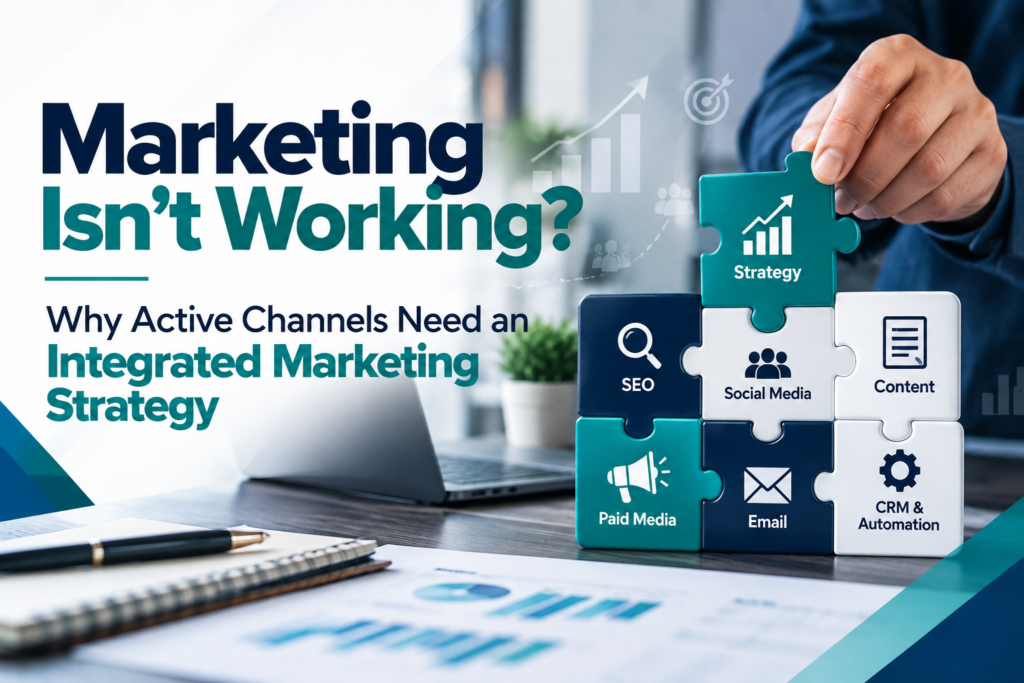
This blog covers why marketing can fail even when every channel is active. It shows how slow lead follow-up, weak tracking, and mismatched pages quietly drain results. You’ll learn how to find the broken handoff and build an integrated marketing strategy that connects your channels.
Introduction
Picture a business owner reviewing the month. The agency report shows more website visitors than last month. Google Business Profile views are up. The Facebook page posted twelve times, the newsletter went out on schedule, and the ad budget was spent in full. Every number is green. The phone, meanwhile, is quiet. The sales team says the leads they do get “aren’t great.”
This is one of the most common situations in small and mid-sized business marketing, and it’s confusing because nothing looks broken. Every channel is active. Somebody is doing the work. Yet revenue barely moves.
The problem is rarely one channel. It’s that the channels were set up one at a time, by different people, for different goals, and nobody owns the space between them. An integrated marketing strategy is what fills that space. This article covers where the gaps usually appear, how to tell which one you have, and what to check before you spend another dollar.
Being Everywhere Isn’t the Same as Working Together
Think of a relay race. Four fast runners can still lose if the baton keeps hitting the ground at the handoffs.
Marketing channels behave the same way. SEO gets judged on rankings and traffic. Paid ads get judged on clicks and cost per click. Social gets judged on engagement. Email gets judged on open rates. Each can hit its own target while the business gets nothing from it, because nobody is measuring the handoff: what happens after the click, the like, or the open.
An integrated marketing strategy doesn’t mean adding more channels or forcing them all to say the same sentence. It means the channels share a few agreed answers:
- Who exactly are we trying to win?
- What do we want them to do next, at each stage?
- How will we know it happened?
- Who follows up, and how quickly?
If those four questions have different answers depending on which channel you ask about, you don’t have a strategy yet. You have a collection of activities.
Start With the Symptom, Not the Channel
When results disappoint, the instinct is to change something visible: switch agencies, raise the ad budget, publish more. That’s usually the wrong first move, because the visible channel is rarely where the leak is. A better habit is to work backwards from the symptom.
| What you’re seeing | What to check first |
|---|---|
| Traffic is up, enquiries are flat | Whether the pages match what visitors searched for, how clear the offer is, and whether tracking is capturing every enquiry route |
| Plenty of leads, few sales | Lead quality, response speed, and whether the promise made in marketing matches what sales can deliver |
| Ad spend is steady, results are thin | Conversion tracking, landing page relevance, and whether the audience is right |
| Rankings look good, phone is quiet | Whether you rank for words buyers actually use, and whether reviews and the page itself give people a reason to call |
| Reports look great, you don’t believe them | Whether the metrics measure activity or outcomes |
Notice that “publish more content” or “run more ads” appears nowhere in the second column. Sometimes volume really is the constraint. But if the system leaks, more input just means more leakage.
Your Leads May Be Going Cold Before Anyone Calls
Of all the handoffs, the one between “someone raised their hand” and “someone responds” is the most neglected, and often the cheapest to fix.
Harvard Business Review researchers audited 2,241 US companies by sending each a test web enquiry. Only 37% responded within an hour, 24% took more than a day, and 23% never responded at all. Among the firms that did reply within 30 days, the average wait was 42 hours. In a separate study of 1.25 million leads, the same authors found that firms that tried to contact a prospect within an hour were nearly seven times as likely to qualify the lead as those that waited longer. You can read the full piece in Harvard Business Review. It’s from 2011, so treat the exact multiples as directional. The habit it describes hasn’t gone away: buyers send several enquiries at once, and the quick reply tends to win the conversation.
Now think about how enquiries actually arrive at a small business. A form submission lands in a shared inbox nobody watches on weekends. A call goes to voicemail during lunch. A Google Ads lead form sends a notification to the person who left the company last year. None of this shows up in a marketing report, because the marketing did its job. The lead simply waited.
Imagine a local roofing company that receives 40 form submissions a month and blames its ad platform for weak results. Before touching the campaign, the owner submits a test enquiry at 7 p.m. on a Thursday. Nothing happens until Monday morning. The ad platform never had a chance to work.
That test takes five minutes, and it’s the first thing worth doing. Submit your own form. Call your own number after hours. Message your own chat widget. Time how long a real person takes to respond, and note what the response says.
A note on nuance: faster isn’t always better for every business. A high-value B2B sale often benefits from a thoughtful reply over a fast automated one. The goal is a defined, dependable first response, not a race. Even so, Salesforce’s tenth State of Marketing report found that 69% of marketers admit they struggle to respond promptly to inquiries, so this gap is common even in well-resourced teams.
The Dashboard Says Healthy. The Bank Account Disagrees.
Reports full of impressions, clicks, sessions, and followers aren’t dishonest. They’re just measuring the early part of the journey, which is the easiest part to measure.
The harder question is how many qualified opportunities the marketing created, and what those became. Answering it takes two things: agreeing on what counts as a meaningful action, and connecting your website data to your sales records.
Start with the first. In Google Analytics 4, nothing is treated as a conversion until someone decides it should be. Google’s documentation explains that you mark an event as a key event to report on it, and standard properties allow up to 30 of them. That sounds simple, but here’s how it goes wrong in practice:
- The contact form is tracked, but phone calls and WhatsApp clicks aren’t, so channels that drive calls look weaker than they are.
- Every button click is marked as a conversion, so the numbers look impressive and mean very little.
- Nobody ever revisited the setup after a website redesign, so half the events quietly stopped firing.
Then comes the second connection. If your CRM doesn’t record where each lead came from, you can’t say which channel produced customers, only which produced enquiries. Those are different things. A channel that delivers cheap, unqualified enquiries can look like a hero in marketing reports and a burden in the sales team’s inbox.
This is a wider industry struggle, not a personal failing. Salesforce’s survey found that only 26% of marketers are completely satisfied with their data unification. Perfect attribution doesn’t exist, and chasing it can waste months. But you can get close enough to see which sources lead to booked appointments, quotes, and closed deals, and that’s usually all you need to make better decisions.
Pages and Content That Don’t Answer the Question Being Asked
Search intent is a phrase that gets thrown around a lot, but it comes down to a simple idea. When someone types a query or clicks an ad, they have a question in their head. The page they land on either answers it or makes them work.
Say someone clicks an ad for “same-day boiler repair” and arrives on a homepage with a company history and a slideshow. They aren’t going to hunt. They’ll hit the back button and try the next result, and your ad spend goes with them.
The same problem shows up in content marketing. A business publishes a blog post every week, but the topics come from a keyword tool rather than from the questions customers ask on the phone. Traffic arrives, and nobody in it is close to buying. Google’s own guidance on helpful, people-first content asks creators to consider whether their content offers original information or analysis that goes beyond the obvious, and whether it’s the sort of page you’d want to bookmark or recommend. That’s a good test for a blog post, and an even better one for a service page.
Consistency matters too. If the ad promises premium, personalised service and the website leads with discounts, visitors sense the mismatch even if they can’t name it. The message from each channel should feel like it came from the same company. Getting your content strategy and your website conversion work to line up is one of the least glamorous and most effective things you can do.
The Weak Point Depends on the Business
There’s no universal fix, because different businesses buy and sell in different ways.
A local service business such as a roofer or plumber typically wins or loses on speed and reputation. People search, compare a few options, and call whoever seems trustworthy and available. Response time, reviews, and call handling matter more than another blog post.
A dental or medical practice, or any professional practice, depends heavily on trust. Booking has to be effortless, and the website has to reassure a nervous first-time visitor. Ranking well helps little if the appointment process is confusing.
A B2B company with a long sales cycle rarely converts on the first visit. Buyers involve several people, read several pieces, and come back weeks later. The question there is whether anything keeps the conversation going between the first touch and the sales call, and whether marketing and sales agree on what a qualified lead is.
A multi-location business faces another set of problems: inconsistent location pages, mismatched listings, calls routed to the wrong branch, and reports that blur good and poor locations together. Strong marketing on paper can hide weak execution in specific places.
Whichever category you’re in, the useful question is the same: where does this business most often lose people between the first click and the first payment?
A Practical Audit You Can Run This Month
You don’t need a large budget to find the gaps. You need an afternoon and a willingness to look at what actually happens.
- Trace the last ten customers backwards. For each one, note how they first found you, what they did next, and who spoke to them. Patterns appear quickly, and they’re often different from what the reports suggest.
- Test your own front door. Submit the form, call the number, and use the chat widget, including outside office hours. Record how long each takes to get a real reply.
- List what you count as a conversion. Then ask the sales team whether each item is what they’d call a good lead. Any mismatch is worth investigating.
- Put your ads, landing pages, and emails side by side. Read them as a stranger would. Do they make the same promise to the same person?
- Ask the people who talk to leads. Which enquiries waste their time? Which are the best ones, and where did they come from?
- Only then decide on channel changes. Some channels will deserve more investment. Others will deserve a fix rather than a bigger budget.
Once you’ve done this, choose a handful of numbers that reflect outcomes rather than activity: time to first response, cost per qualified opportunity, lead-to-customer rate by source, and revenue by source. If you can’t yet produce those, building that visibility is the project, not a side task.
Where Connected Systems Help, and Where They Don’t
Some businesses can fix a good share of this alone. A clear owner for lead follow-up, a tidy set of tracked events, and a shared sheet where sales notes each lead’s source can go a long way.
Others hit a ceiling because the problem sits across disciplines. The fix might involve search visibility, the landing page, the CRM setup, an automated first response, and reporting all at once. When each of those belongs to a different vendor, nobody sees the whole picture. This is the kind of work where a consultancy that covers strategy, SEO, paid advertising, CRM implementation, marketing automation, and analytics can be useful, because it can design the whole system and then measure whether it works.
An integrated marketing strategy isn’t a bigger plan. It’s a plan where the parts are accountable to each other.
What to Do Next
If your channels are busy but you can’t say how they add up to revenue, the first step is rarely another campaign. It’s finding the handoff that’s failing: the slow reply, the untracked call, the page that doesn’t match the ad, or the report that measures the wrong thing.
Start with the five-minute test on your own contact form. Then trace your last ten customers. You’ll likely learn more from those two exercises than from your next monthly report.
If you’d like a second pair of eyes on where your marketing system is breaking down, talk to the AJZ Consultants team. We’ll start with the problem, not a package.
Frequently Asked Questions
What is an integrated marketing strategy?
An integrated marketing strategy is a plan where every channel works from the same audience definition, message, and goals, and where tracking follows a person from first contact to closed sale. SEO, ads, email, social, and sales follow-up stop operating as separate projects and start operating as one system with shared handoffs.
Why isn’t my marketing working when I’m active on every channel?
Usually because the channels aren’t connected. Common causes include pages that don’t match what people searched for, slow or missing follow-up, tracking that misses calls and bookings, and reports that measure clicks instead of qualified opportunities. Being active shows effort, but results depend on what happens between the channels.
How do I know which part of my marketing is broken?
Start with the symptom. If traffic is up but enquiries are flat, check page relevance and tracking. If leads come in but sales don’t, check lead quality and response time. Then test your own front door by submitting your form and calling your number, and trace your last ten customers back to their first touch.
How fast should a business respond to a new lead?
As fast as you can reliably manage. Harvard Business Review research found that firms contacting leads within an hour were far more likely to qualify them than slower firms. That study is from 2011, so treat the exact figures as directional. For high-value B2B sales, a thoughtful reply can matter more than an instant one, so aim for a defined and dependable first response.
Do I need a marketing consultancy to build an integrated marketing strategy?
Not always. A small business can fix a lot with a clear owner for lead follow-up, properly tracked conversions, and a record of where each lead came from. A consultancy becomes useful when the problem spans several areas at once, such as SEO, landing pages, CRM setup, automation, and reporting, and different vendors each hold one piece. If that sounds familiar, talk to the AJZ Consultants team.