
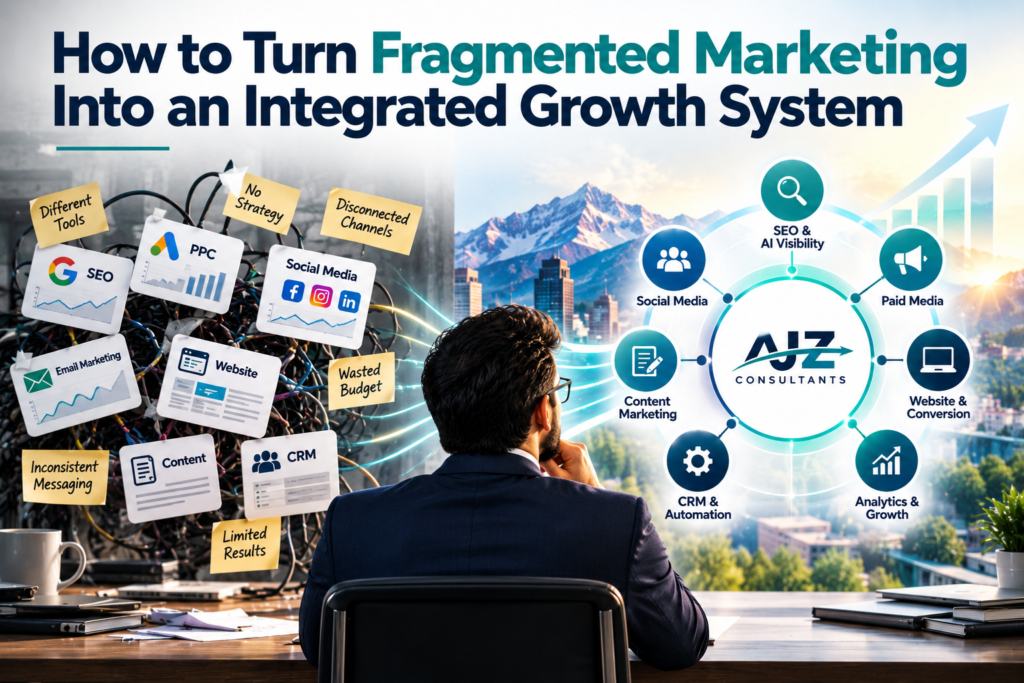
Quick Summary:
Most businesses don’t have a lead problem. They have a handoff problem between SEO, ads, email, the website, and sales. This post shows where fragmented marketing breaks, what the research says it costs, and how to build an integrated growth system in four practical steps.
Introduction
Turn to the reports of your previous month’s marketing. Search engine optimization (SEO) report has a list of rankings. Click activity is displayed on the ad platform. Open rates are displayed in the email tool. If anyone does update the CRM, it shows the pipeline that does not reflect the three.
The individual reports are all OK. They simply can’t answer the one question you’re interested in: What was this all for in revenues?
It is this “gap” that is the real-life example of fragmented marketing. No one was to blame. There is someone who did SEO, someone who did ads, someone who created the website and someone who selected the CRM. Every piece works. Nothing connects them. An integrated growth system remedies that by having the pieces respond to the same objective and provide the same information.
Why Marketing Fragments in the First Place
It’s not often an accident. It’s happening by a growth process. A channel gets added when you need leads, a tool when you need to save time and a freelancer when you’re short on time. The decisions address actual problems of the week.
After 2 or 3 years you have a set of solutions that have no common sense. The ad team is not aware of what the website has published on the SEO team’s blog. Sales is clueless as to which campaign generated which lead. The website has one story, the emails have another story and the individual who answers the phone has a different story.
If you’ve heard this before, you’ve heard it a million times before. A survey of 4,450 marketers by Salesforce revealed that the typical organisation stores data in seven sources but only 26% are completely satisfied with the level of integration between those sources.
You can read the full breakdown in Salesforce’s marketing trends analysis.
Where the Seams Show
Fragmentation hides in the gaps between teams and tools, so you won’t spot it by looking at any single channel. These are the places I’d check first.
| Where it breaks | What you see | What it costs you |
|---|---|---|
| Ad to landing page | The ad promises one thing, the page opens with something else | Paid clicks that leave in seconds |
| Form to first reply | Enquiries sit in an inbox until someone has time | Leads who contact your competitor instead |
| Website to CRM | Leads arrive with no source attached | You can’t tell which channel produces customers |
| Marketing to sales | Each team defines a “good lead” differently | Sales ignores leads, marketing blames sales |
| Tracking setup | Calls, chats, and bookings go unmeasured | Strong channels look weak, weak channels look strong |
Notice that none of these problems belong to SEO, or ads, or email. They belong to the space between them, which is exactly why no single specialist ever fixes them.
What the Research Says About Connected Systems
Disconnection costs more than tidiness. Salesforce’s tenth State of Marketing report found that 69% of marketers struggle to respond promptly to customers, while marketing teams that have satisfactorily unified their data are 42% more likely to respond regularly. Better data didn’t make those teams smarter. It gave them the context to act quickly.
Forrester reached a similar conclusion from the revenue side. Its research found that firms with high levels of alignment across customer facing functions report 2.4x higher revenue growth and 2x higher profitability growth than firms without it. The details are in Forrester’s announcement. Treat that as a directional signal rather than a promise, since results depend on how a business aligns and what it starts from. Still, the pattern holds across several studies: connected beats disconnected.
Step 1: Agree on What a Win Looks Like
Connect the people first before any tools. Inquire to the marketing and sales team the same question: “What does a good lead look like?”
There are two different answers which you will likely receive. Any form submission could be considered a marketing event. It may be sales who only take people with a budget and a deadline. Both perspectives are correct from a team’s point of view and a disparity in the number of leads being created is why leads continue to get lost between departments.
Must write one common definition. Add the service they requested, location (if it’s relevant) and how they reached out to you. Next, narrow down to two or three outcome numbers that all report on, for instance, qualified opportunities, cost per booked appointment, and revenue by source. All other becomes subsidiary.
Step 2: Follow One Lead From Click to Cash
Choose a customer from last month and follow their journey back. Who introduced you to the Lord? What did they read? What was the name of the person who called them and how much time did it take?
The last question is of particular interest. In an experiment, researchers at Harvard Business Review sent test inquiry to 2,241 US companies and received a response from 37% within an hour and 23% didn’t respond at all. They also discovered, in a different study of 1.25 million leads, that companies that reached out to a prospect within 1 hour were almost seven times more likely to qualify that lead than those that took longer to reach the prospect.
The full article dates from 2011, so use the exact multiples as direction, not gospel. What hasn’t changed is the behavior of buyers, who generally reach out to multiple businesses simultaneously, and the first useful response may have the advantage.
Next test your own front door. Submit your form outside business hours. Call your main number. Utilize chat widget. Time every reply. This exercise is free of charge, and typically reveals a problem in just one afternoon.
Step 3: Connect the Tools That Touch the Customer
Now you can decide which tools need to talk to each other. For most small and mid sized businesses, three connections matter more than the rest.
First, your website and your analytics. In Google Analytics 4, nothing counts as a conversion until you decide it should. Google’s guide to marking events as key events walks through the setup. Track phone calls, bookings, and chat starts alongside form submissions, or you’ll undervalue every channel that drives them.
Second, your website and your CRM. Every lead should arrive with its source attached: the channel, the campaign, and the page. Without that, you can only measure enquiries, never customers.
Third, your CRM and your follow up. A lead who submits a form at 7 p.m. should receive an acknowledgement immediately and a clear next step. Basic marketing automation handles this well, as long as a real person follows up quickly after it.
Your content should connect too. Google’s guidance on helpful, people first content asks whether a page serves the reader’s actual need. Apply that to your ad landing pages, service pages, and emails together. When they make the same promise to the same person, your content strategy starts working as one system rather than three separate efforts.
Step 4: Give the System an Owner and a Rhythm
If you don’t own it, it will disintegrate. Someone must ask the question about the handoffs each month without exception, and without the need to pay lip service to the issue.
This doesn’t require a prestigious position or title. In small business it could be the owner. It could be a marketing manager or an outside party in a larger one. They’re not looking at each channel’s private metrics, and they can make changes across channels, what matters is the outcome numbers they are looking at are the shared ones.
Maintain the simplicity of the rhythm. Review the three outcome numbers, check response times and view lead quality by source once a month. Make a point of determining once a quarter which channel is more valuable to invest in and which is in need of improvement so it can get its next dollar.
What an Integrated Growth System Looks Like Across Business Types
The principles stay the same, but the weak points move around.
| Business type | Where fragmentation usually hurts | First fix to try |
|---|---|---|
| Local service business | Slow response, untracked calls | Call tracking and a same day reply process |
| Professional practice | Clunky booking, weak trust signals | A simpler booking path and visible reviews |
| B2B company | No follow up between first visit and sales call | Shared lead definition and nurture emails |
| Multiple location business | Inconsistent listings and mixed up reporting | Location level tracking and one reporting view |
Pick the row that matches your business and start there. You don’t need to fix everything at once.
Start Small and Make the Connections Visible
You don’t need a new platform to begin. You need one shared definition of a good lead, one trace of a real customer, and one honest test of your response time. Those three exercises often reveal more than a quarter of channel reporting.
An integrated growth system isn’t a bigger marketing budget or a longer tool list. It’s marketing where each part knows what the others are doing and answers to the same result.
If you’d like help finding where your handoffs break, talk to the AJZ Consultants team. We’ll start with how your system works today, not with a package.
Frequently Asked Questions
What is an integrated growth system?
It’s a marketing setup where SEO, ads, email, your website, your CRM, and sales follow up share the same goals, definitions, and data. Instead of each channel reporting on its own, the whole system tracks a customer from first click to closed sale.
How do I know if my marketing is fragmented?
Look for three signs. Your reports can’t tell you which channels produce customers. Marketing and sales disagree about lead quality. Leads wait hours or days for a reply. Any one of those points to disconnected handoffs.
Do I need new software to integrate my marketing?
Usually not at first. Most businesses can improve a lot by agreeing on one lead definition, tracking calls and bookings properly, recording each lead’s source, and assigning a clear owner for follow up. Software helps once you know what it needs to connect.
How long does it take to build an integrated growth system?
You can run the basic diagnosis in a week or two. Fixing tracking, response processes, and CRM setup typically takes a few weeks to a few months, depending on your tools and team. The system keeps improving as you review results monthly.
Should I hire a consultancy or fix this internally?
Smaller businesses can often handle the basics themselves. Outside help becomes more useful when the problem spans several areas at once, such as SEO, paid ads, website conversion, CRM, and analytics, and different vendors each hold one piece. Talk to the AJZ Consultants team if that sounds like your situation.