
Quick Summary
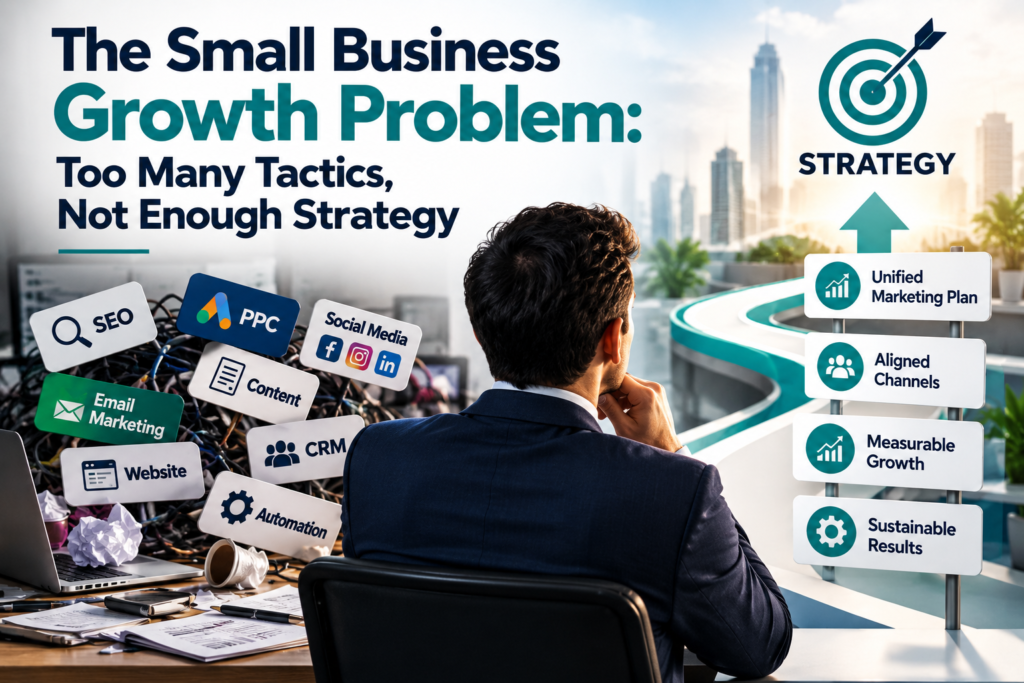
Most small businesses do not fail at marketing because they avoid using tactics. They fail because they add many tactics without a clear plan to connect them. This post explains why this occurs, what it leads to and how to create a business marketing strategy that really works.
Introduction
Ask a business owner what their marketing plan looks like and you’ll usually get a list. Social media, a Google ads, a newsletter, maybe a blog and TikTok because a competitor just joined. Push a little deeper. Ask why each thing is there. That’s when the answers start to fade
That’s where the real problem lies. It’s not about effort. It’s not about channels. The issue is a small business marketing strategy that clearly defines what the business actually does in what order and why it matters.
You can slip into this without realizing it. Each choice seems logical on its own. Someone suggested Instagram so you started posting. An ad representative called so you gave a campaign a try. A competitor launched a podcast so you thought about doing one. None of these decisions were wrong, by themselves.. No one ever stopped to ask if they fit together. No one asked if they made sense as part of something.
Tactics Aren’t Strategy, Even When They Work
A tactic is an action you take like posting on Instagram running a Google ad or sending an email. A strategy is what tells you which tactics are worth your time, in what order and what each one should achieve. Most small businesses can name their tactics without thinking.. Few can explain why they picked that order, who each tactic is meant for or what would show it’s actually working. That’s not a flaw. Running a business already takes everything you’ve got.. Marketing advice comes from everywhere. One person says video is the key. Another insists email is the best. A salesperson pushes a CRM system you didn’t ask for. Trying something new feels like progress. Sitting down to plan feels like doing nothing—even though it usually brings results in the long run.
How Businesses Land Here
A handful of patterns show up over and over.
The next shiny platform. A new app launches, gets hyped at a conference, and suddenly feels mandatory, whether or not your customers actually use it.
Agencies that sell channels, not outcomes. Some agencies package their services around what they sell: an SEO retainer, a social package, a PPC package. Nobody on their end questions whether you need all three yet, because selling more is the incentive. You can end up paying three vendors who never talk to each other.
No single owner for the whole picture. The owner handles social between calls, a part time hire runs the website, an agency manages ads. Each person does their slice well. Nobody owns how the slices fit together.
Fear of missing out. A competitor shows up loudly on a channel, and you follow without checking whether that channel is driving their results or just their visibility.
None of this makes a business careless. It just means most small businesses are living inside a version of one of these patterns right now.
What the Gap Actually Costs
From the nothing looks catastrophic. The budget is spent content is. The business continues to exist.. Growth is slower than it ought to be and marketing feels like a chore rather than a lever.
CMOtech UK reported that 31.4 percent of UK small and medium businesses had a formal marketing action plan and that share dropped from 41.1 percent in 2020 to 25.3 percent in 2024. Many businesses spend money on marketing without a shared answer to a basic question: what do we want to achieve and how will we know marketing is working?
The gap grows. A business juggling five disconnected tactics rarely performs five times better than a business running one chosen tactic. The business often performs worse because attention splits, marketing messages drift between channels and no one has the bandwidth to execute any task properly. Enjis 2025 State of Small Business report surveyed 245 business owners across 40 states and found that owners with a documented marketing plan were three times more likely to follow through on their planned tasks and three times more likely to call marketing effective. The same report found that owners who consistently completed marketing tasks reported 58 percent burnout than owners who did not.
That connection is not really about the document itself. Writing a marketing plan forces the business to decide before spending a dollar, who the business is reaching what the business wants them to do and which one or two channels actually deserve the businesss time.
Tool sprawl tells the story from a different angle. HubSpots research on marketing tool overload found that over half of marketers use five or more tools more than a quarter juggle over ten tools with over fifty percent spending, at least thirty minutes a day just integrating and managing those tools. Separately G2s State of MarTech report found that smaller businesses tend to run tools with fifty-three percent subscribing to just one to three tools yet still report that cost and complexity dominate their decisions. More tools rarely mean strategy. They usually just mean things to keep straight.
What a Small Business Marketing Strategy Actually Answers
This doesn’t need to become a fifty page document nobody opens again. For most small and mid-sized businesses, a working strategy answers five questions clearly enough that two different people in the company would give matching answers.
| Question | What it forces you to decide |
|---|---|
| Who are we actually trying to reach? | Not “everyone,” but the specific buyer most likely to act soon, and what’s true about their situation right now |
| What do we want them to do? | One clear action: call, book, request a quote. Not three different actions across three channels |
| Which one or two channels reach them best? | The channel where your real customers already spend attention, not the one currently trending |
| What does success look like, in numbers? | A target you can check: qualified calls per month, cost per booking, lead to customer rate |
| Who owns the connection between channels? | Someone has to own the handoff, even if that’s the owner themselves at first |
Notice that platforms don’t appear anywhere in that table. A strategy decides what the business needs. The tactics come after, not before.
The Plan Looks Different for Different Businesses
A roofing company and a dental practice are both small and local. They don’t need the same strategy.
A local service business, like roofing, plumbing, or HVAC, usually gets found when someone has a problem right now. The real strategy question isn’t which platform to join. It’s whether you show up when people search and whether you respond quickly once they find you. One solid optimized Google Business Profile and a landing page focused on your main services often does more than five accounts that are barely kept up.
For a practice, like a medical office the focus shifts. Here trust and simple booking matter more than how much content you post. The strategy question becomes: Does a first-time patient feel at ease? Can they book an appointment without confusion? Not whether the office posts every day.
A B2B company works differently. Most buyers don’t close on the visit. They research, compare, maybe walk away for weeks or months. The strategy question then turns to what keeps them engaged between that meeting and the final decision. Usually it’s a mix of content consistent email follow-up and a sales process that picks up where the last conversation left off.
A multi-location business faces its challenge: consistency. The strategy question changes from “which channel” to whether every single location represents the brand. Are results tracked the way across all locations? Does one underperforming store get hidden behind an average that makes everything seem fine?
In each case the fix is not, about adding tactics. It’s about choosing, on purpose the things that actually matter for that business—and giving those the attention needed for them to work.
Fewer Channels, Run Properly, Usually Win
This runs against instinct, but it holds up: a business running two channels with a clear plan usually beats a business running six channels with no plan, even on a smaller budget.
Every extra disconnected channel adds coordination cost. Someone has to write for it, monitor it, respond to it, and keep its message consistent with everything else. A small team with limited time pays that cost repeatedly without the results multiplying to match.
This doesn’t mean a business should never add channels. It means expansion should follow a decision, not a trend. Add a channel once the first one or two are working and you understand why. Add it because your customers are genuinely there, not because a tool made it easy to start.
Building the Plan Without Overbuilding It
This exercise takes an afternoon, not a quarter. Write down every marketing activity that your business is running. Next to each marketing activity write the audience that marketing activity is meant to reach the action that marketing activity wants that audience to take and whether you can see if marketing activity is working now. Many marketing activities will fail that test away. That is information, not a failure.
From there pick one or two marketing channels that are clearly linked to real customers. Commit to running those marketing channels for a set period before adding anything new. Running a marketing channel correctly usually means doing it tracking it well and directing it toward a clear next step for the visitor. This approach does not mean doing it often or spending more.
Be honest, about how much time your business can use while you do this. A plan that expects an owner to spend an hour a day when the owner only has fifteen minutes is not a strategy. It is a wish list. Match the plan to the time and people that your business actually has not to a world.
What to Do Next
If your business runs several channels and still isn’t growing the way it should, the next move probably isn’t a new platform or a bigger budget. It’s an honest look at whether your current activity adds up to a plan, or just a list of things someone decided to try.
Write down what you’re doing, why you’re doing it, and what each piece is supposed to produce. If you can’t answer those questions for most of your current channels, start there instead of adding the next tactic to the pile.
If building that plan feels like more than you can fit around running the business, that’s exactly the work a growth consultancy handles: reviewing what you’re currently doing, identifying what’s actually working, and building a small business marketing strategy around the channels that deserve your attention. Talk to the AJZ Consultants team if that would help.
Frequently Asked Questions
What is a small business marketing strategy, in practical terms?
It’s a clear answer to five questions: who you’re trying to reach, what you want them to do, which one or two channels reach them best, what success looks like in numbers, and who owns connecting the pieces. It doesn’t need to run long, but it does need to exist somewhere everyone on your team can check.
How do I know if I have too many tactics and not enough strategy?
Test it directly. For each marketing activity you run, can you explain who it targets and what you expect it to produce? If several answers come back vague, or if different people in your business would describe your approach differently, you’re likely tactic heavy and strategy light.
Should I focus on fewer marketing channels?
In most cases, yes, especially with a small team and limited time. A business running one or two channels consistently, with a clear plan, tends to beat one spreading thin attention across five or six. Add a channel once your current ones are working and you understand why, not because it’s trending.
How often should I revisit my marketing strategy?
Checking in monthly or quarterly works for most small businesses. That’s frequent enough to catch what’s working without chasing every short term shift. The channels can flex as results come in, but the core questions, who you’re reaching and what you want them to do, rarely need to change that often.
Do I need an agency to build a marketing strategy?
Not always. Many small businesses can draft a workable strategy themselves after an honest afternoon reviewing their current activity. Outside help becomes more valuable once the picture spans several disciplines at once, like SEO, paid ads, a website, and a CRM, and nobody internally has the time or background to connect them. Talk to the AJZ Consultants team if that’s where you are.
Must Read:
-
Marketing Isn’t Working? Why Active Channels Need an Integrated Marketing Strategy
-
How Artificial Intelligence Is Changing the Future