
Quick summary:
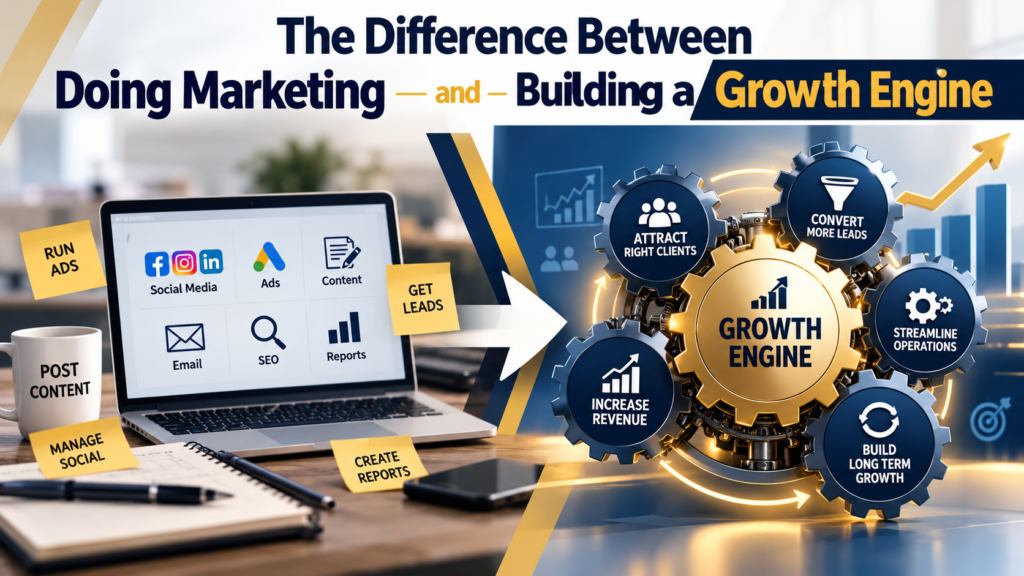
Most small businesses are busy with marketing and never actually build a growth engine (the connected system that takes your effort and turns it into predictable customers). This post looks at the difference between the two, what the research tells us about the gap and how you can start to build the real thing.
Introduction
Imagine a business owner on a Friday afternoon. She posts on Instagram, she boosts a post for $20, she answers two emails from the agency and she approves the blog draft. Every single thing has a tick. She’s worked hard and she can show it.
Ask her what next month’s revenue will be and she can’t say. She can’t tell you which of those tasks will actually be the important ones. The week was productive in that it was a productive week, but it didn’t feel like it was leading anywhere.
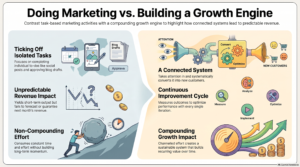
That’s the difference between doing marketing and building a growth engine. Doing marketing is about ticking boxes. A growth engine is a connected system that takes attention in, turns it into customers, measures what happens and then improves with each cycle. Both require effort. Only one of them compounds.
Why Doing Marketing Feels So Productive
Activity gives you instant feedback. You post and someone likes it. You send an email and someone opens it. You run an ad and the click counter goes up. Those little hits are progress and they keep you going.
A growth engine gives you the slower, more grungy feedback. Did the lead convert? How long did it take for the reply to come? Which channel generated the people who actually stayed? Those are the questions you have to ask and they require setup, discipline and sometimes some rather unpleasant answers.
Most businesses end up going for the easy feedback. There’s nothing wrong with the tasks per se. The problem arises when the tasks themselves become the objective rather than the customers that they were meant to create.
Five Differences You Can Spot Quickly
You don’t need a consultant to know which camp you’re in. Just compare how they deal with the fundamentals.
| Doing marketing | Building a growth engine | |
|---|---|---|
| Goal | Finish the task list | Produce qualified customers, measured in numbers |
| Ownership | Each channel has its own person or vendor | Someone owns the whole path from first click to sale |
| Measurement | Clicks, likes, impressions | Qualified leads, cost per customer, revenue by source |
| Follow through | Leads wait for whoever has time | A defined reply process with a clear time limit |
| Learning | Repeat what you did last month | Review results monthly and change what the data says |
If the majority of your answers are in the left column then you’re not behind at all. You’re where most businesses are. It does tell you where to spend your next hour.
The Tools Probably Aren’t Talking
Lots of businesses will try to deal with this by purchasing software. The software only helps when someone actually connects it and uses it.
Gartner surveyed 324 marketers in 2022 and found that they were only utilising 42% of the capabilities in their martech stack (down from 58% in 2020). The reasons cited were overlapping tools, difficulty in finding people to drive adoption and increasing complexity. The full details are in Gartner’s press release. Coverage of the 2023 survey reported the figure had continued to fall to 33%.
The data is the same. Salesforce found the average organisation is managing data across seven sources and only 26% of marketers say they are completely satisfied with the way those sources are connected. Their marketing trends analysis has the full picture. The smaller business has fewer tools than the larger one, but the pattern is the same: you end up with more tools than you have connections between them.
Why Connected Beats Busy
On the revenue side Forrester found that organisations with a high degree of alignment across their customer facing functions achieve 2.4x greater revenue growth and 2x greater profitability growth than those that don’t. The announcement provides the context. The multiple is a signal not a promise as the outcome is dependent on where you start from and how well you align. That said the direction is exactly what you’d expect from the day to day experience of practitioners; teams that are aligned on goals and share data will outperform teams that are working in silos.
Note what Forrester actually measured. It was alignment not volume. The winners didn’t do more marketing. They did marketing that was aligned.
What a Growth Engine Actually Contains
Get rid of the jargon and every working growth engine has the same five parts regardless of what the business is selling.
Attraction. You get found via search, via ads, via referrals, via content. Google’s guidance on helpful, people first content is a good test of every page and every post really (does it meet a real need?). Good SEO and content work absolutely belongs in this area as long as it’s connected to the bits below.
Capture. If someone shows interest you record that with the source. A phone call, a form, a booking, a chat start all count. In GA4 nothing is a conversion until you decide it should be so Google’s guidance on what constitutes a key event is absolutely critical.
Response. Someone responds quickly with something useful. HBR researchers found that companies that contacted their leads within an hour were nearly 7 times more likely to qualify them than those that didn’t (study of 1.25 million leads). The article in its entirety is from 2011 so the ‘multiple’ is just a guide, not a hard and fast rule. The practice they’re talking about has not changed.
Conversion. That’s the next step that turns interest into a booking, a quote or a sale. That’s where your landing pages, sales calls and follow up sequences all come in. A CRM and automation in place stops it all leaking.
Learning. You look at the numbers, you ask what’s changed and you adjust. That’s what separates an engine from a machine that just runs. Without that learning element you’re just going to repeat last month’s mistakes with greater confidence.
A Quick Way to Tell Which One You Have
Try those four questions and answer them without even opening a dashboard.
Where did your last 5 customers first hear about you? If you don’t know then your capture stage has a hole.
How long did each one actually wait for a first reply? If you don’t track that then your response stage is running on hope.
Which channel gives you the cheapest qualified lead? If you only know the cheapest lead then you’re measuring volume not quality.
Who reviews all of this together every month? If the answer is ‘nobody’ or ‘each vendor reviews their own bit’ then you’ve found your missing owner.
Those four answers will usually account for more than a quarter of the reports.
How to Start Building One
You don’t need to do it all at once. Sequence the work so that one step makes the next one easier.
Firstly, agree on what a good lead is and document that so both sales and marketing can see it. Second, fix the front door (response time, tracking and the page the visitor lands on). Third, integrate your website, your CRM and your follow up so that every lead has its source. Fourth, pick three KPIs (e.g. number of qualified leads, cost per qualified lead, revenue by source) and review them on a monthly basis. Only once you’ve done that can you then go and decide which channel is going to get more of the budget.
Your business type is the weak point. A local service business will typically fail on response time. A professional service business will fail on booking friction and trust signals. A B2B business will fail between the first visit and the sales call. A multi location business will lose clarity if it’s reporting the strong locations and the weak locations together. Start where your business is leaking.
Put the Engine Before the Fuel
If your calendar is full but your future revenue is still up in the air then just adding more tasks won’t do a thing. It’s about building the links between the tasks.
Start small. Trace your last five customers from first click to payment. Test how quickly your business replies. Write down who owns the entire path. That’s how a growth engine starts, long before you need to spend any more money.
If you’re looking for help in taking your marketing from a series of disparate activities into a connected system then get in touch with the AJZ Consultants team. We’ll start with an assessment of how your marketing works at the moment and then build from there.
Frequently Asked Questions
What is a growth engine in marketing?
A growth engine is a connected system that draws in people, hooks them, responds rapidly, turns them into customers and learns from the outcomes. It’s not simply a series of disparate tasks each with its own objectives and definitions. All the elements are aligned to the same goals, same definitions and same data so the results build on each other over time.
What’s the difference between doing marketing and building a growth engine?
Marketing is about the actual activities of posting, advertising and emailing. A growth engine is about linking those activities to tangible customer outcomes, with a clear owner, a defined process for dealing with replies and a regular review of what you do next.
How do I know if my marketing is just activity?
Look for three indicators. You can’t say which channels are actually producing customers. Leads sit around for a very long time before they get a response. Each vendor or team will have their own set of figures to report and there is no single shared view of the activity. Any one of those points to activity without an engine behind it.
How long does it take to build a growth engine?
You can do a basic diagnosis in a couple of weeks. Getting tracking sorted, getting the reply processes in place and setting up your CRM will take a few weeks to a few months (it really depends on your tools and your team). The engine will of course keep getting better as you go through the results every month.
Do I need an agency to build one?
Not necessarily. A lot of small businesses can quite easily deal with the fundamentals themselves by defining what a good lead is, tracking calls and forms and having one person responsible. External help is where it really comes into its own when you’ve got a problem that spans a number of areas (e.g. SEO, ads, website, CRM, analytics) and each of the various vendors has a different piece of the puzzle. If that’s the situation you’re in then get in touch with the AJZ Consultants team.